Summaries
Session summaries from ESLAB & Heliophysics in Europe
Session 1: ESA Heliophysics activities
ESLAB and ILWS Hermann Opgenoorth Memorial Session
See https://www.cosmos.esa.int/web/esa-heliophysics/heliophysics-in-europe-2026
Session 2: Contributed Science
This session was run as both poster session and 3-minute lightning talks from each author.
See Posters
Topic 1: Cross-cutting science in the heliosphere and beyond
Topic 2: Putting Science into Space Weather
Topic 3: Methods, missions, tools, and instrumentation
Topic 4: Open topic (contributions not covered by the above)
Session 3: Data, Tools, Modelling & Simulation
Tuesday 22 September 2026, 14:30-18:00
Chair: Ashley Smith & Guram Kervalishvili
- 14:30 Talks by Arnaud Masson & Jorge Amaya (slides © the speaker, CC BY 4.0 unless stated)
- Arnaud Masson: Information architecture (PDF, 9.2 MB)
- Jorge Amaya: Space Weather and Heliophysics Modelling in Europe (PDF, 1.9 MB)
- 15:00 Panel discussion with questions submitted using Particify
Arnaud Masson, Jorge Amaya, Michaela Brchnelova, Eelco Doornbos, Matthew West - 16:00 Coffee break
- 16:30 Demos:
- Eelco Doornbos: Timeline Viewer
- Alexis Jeandet: SciQlop
- 17:00 Group discussions facilitated with Collaboard
Questions (17)
Questions for the panel, submitted by participants via Particify and sorted by votes. Questions discussed in the session carry a short note from the panel. Download all questions as CSV: panel-questions.csv (3 KB).
- Looking ten years out, where is the biggest gap in European modelling? eg. physics, coupling, validation, facilities, or sustained funding to maintain what exists? ▲ 10 votes ✓ discussed Panel saw forecasting as the biggest scientific gap: flares, coronal holes and coupling physics across timescales, all needing new observations. Funding was named as the overarching challenge; the community should actively make the case to ESA/EU delegates, e.g. through white papers on required funding.
- Should we have standardised performance metrics for space weather models, and if so, who and what should they determined by? ▲ 8 votes ✓ discussed Metrics need an agreed baseline to compare against; defining criteria is most achievable for impacts on satellite operations. Users already rely on indices and scales (e.g. NOAA G/R scales), but how well these capture the hazard to end users is open; suggestion to review existing scales and adapt them for Europe.
- How do we ensure that good datasets/software that are freely available are used by the community, not just lost in the open research section of a paper? ▲ 8 votes ✓ discussed Version and archive software publicly (e.g. at the end of a PhD/postdoc) so it can be reused and results reproduced; journals are starting to address software updates. Panel favoured community-built tools (e.g. the Python in Heliophysics Community) over single-person projects, which need sustained funding and people to maintain them. ESA needs a better long-term plan for development activities, and could look to the Earth Observation community for how to do this.
- Concerning the topic of getting Science and Software engineers together: You mentioned using Software engineers from companies instead of within academia. How would you propose the workflow to be, both concerning finding funding to hire those engineers within projects and then communication between scientists writing code and the engineers refining it? ▲ 6 votes ✓ discussed Models discussed: science centres pairing scientists and engineers (e.g. IRAP Toulouse), involving companies to mature tools from TRL 4 to 7, NOAA’s embedded software-engineering teams, and UK research software engineers teaching best practice. Funding routes include proposals and Horizon Europe, but scientists need to reach out; recruiting computing talent against industry salaries is hard.
- What fundamentally changes for heliophysics with the Vigil mission, and how should the community adapt to fully exploit this new perspective? ▲ 6 votes ✓ discussed Vigil is designed as a low-risk operational mission to raise forecast capability, with L5 giving advance view of regions before they reach the L1 line. Its data will be openly available, and the community is encouraged to use it and feed back; data-sharing agreements are in place with partner agencies and ground-based providers. Improved inputs could enable probabilistic forecasts, e.g. of the thermosphere for satellite collision avoidance.
- What should data providers and curators do to make their data easier to find and use, and what can the rest of us as a community do to support them? ▲ 6 votes ✓ discussed Providers should clearly advertise what their data and tools can do; usage tracking (publications, software) helps managers justify support. Contact points for data access are often missing or out of date, and a single access point would help; ESA’s Space Weather Service Network is working to improve this.
- Who should be writing and maintaining the software our science depends on, and how do we fund and reward them? ▲ 6 votes
- How does ESA envision the research to operations pipeline and how do you support researchers throughout it ▲ 4 votes
- What would it take for European space weather services to keep running if a key external data stream or model went dark? ▲ 4 votes
- What is the one thing missing from the European pipeline that would most improve swx alerts and forecasts today? ▲ 3 votes
- How do we balance sovereignty and openness? What role do open standards play? ▲ 3 votes
- The lack of exchange between end users and scientists was mentioned a few times now, as well as the disconnect between their expectations to what we know is currently possible. How can we improve this? Dedicated meetings/sessions that facilitate this exchange? Deliberately inviting representatives to meetings like this? Better outreach (and funding for it)? ▲ 2 votes
- Is it useful to make data itself a citable object (i.e. DOI)? Does this encourage higher data quality/calibration? ▲ 2 votes
- How does geopolitics effect ESA decisions on data policy and model capability protection ▲ 2 votes
- How (by which sponsor) should the database covering both from ground and space be constructed and maintained, other than ESA? ▲ 2 votes
- How can we improve the interface between satellite operators and scientists, so that scientific knowledge is translated more effectively into operational needs? ▲ 1 vote
- What future mission would you be most excited for your science? ▲ 0 votes
Group discussion
Seven groups worked through four prompts on a shared whiteboard. The synthesis slide below summarises which ideas came up across groups.
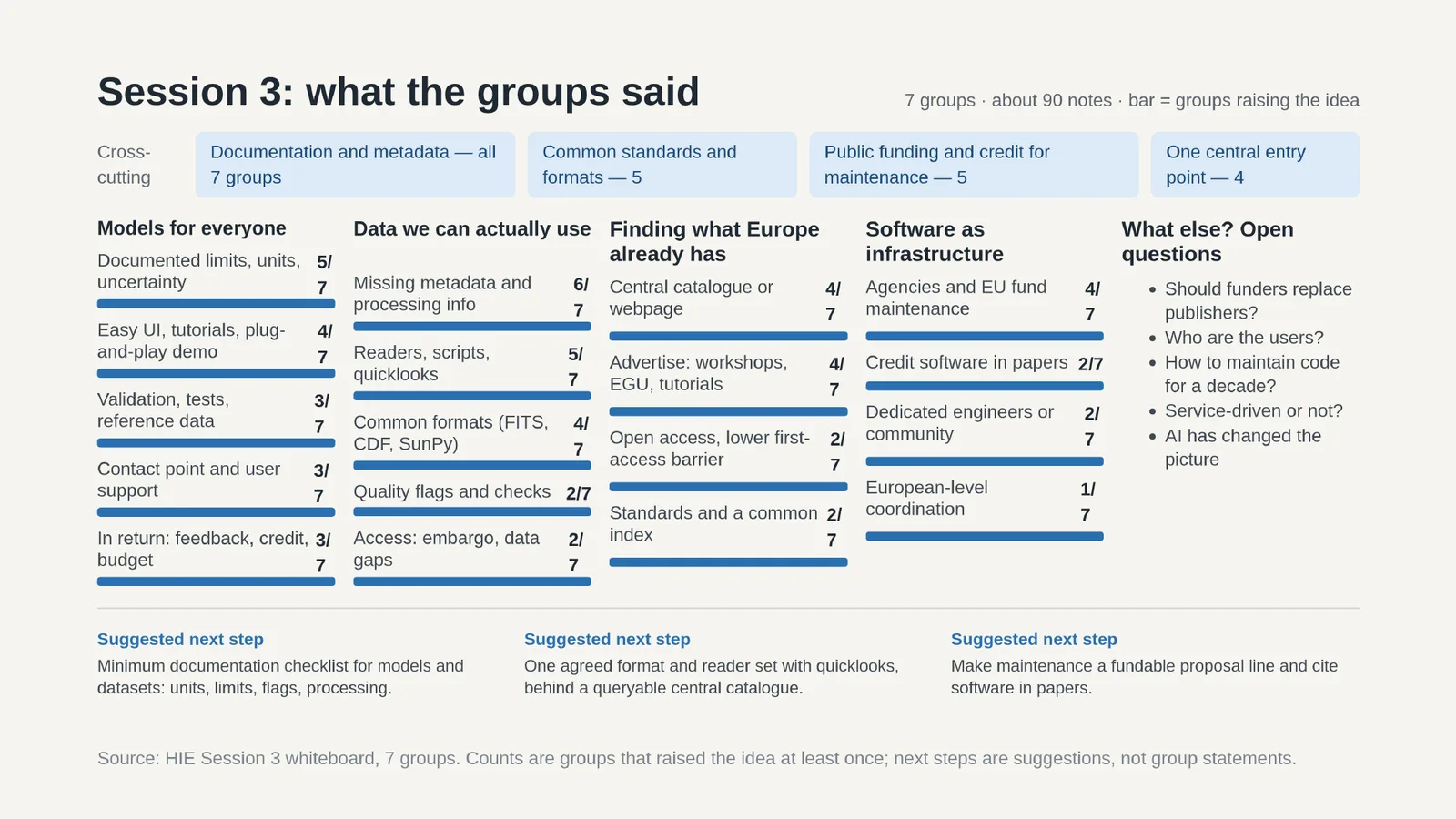
What the groups said (PDF, 1.0 MB)
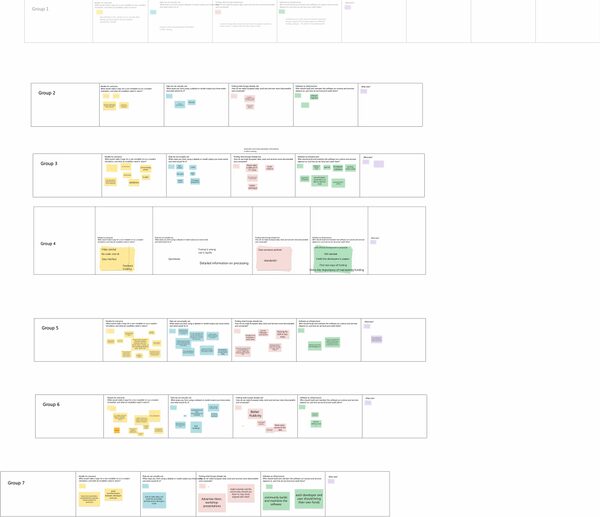
Action points for the community:
- Document what you release. As part of publishing a model, dataset or tool: units, validity limits, uncertainty, quality flags, processing history, version number, public archive, persistent contact point, …
- Make European data and tools findable and usable. Converge on common formats and readers (FITS, CDF, SunPy/PyHC) with quicklooks, and register resources in shared queryable entry points (eg ESA’s Space Weather Service Network). Advertise capabilities through workshops, EGU and tutorials. Build on community tools rather than one-person projects.
- Make the case for sustained funding and credit. Push for software maintenance and research software engineers to be fundable lines in ESA/EU proposals. Cite software and data in papers so usage can be tracked. Put the case to ESA/EU delegates directly, e.g. through community white papers on required funding.
Session summary, panel questions, whiteboard and synthesis © EHC / workshop organisers, shared under CC BY 4.0.
Session 4: How do we build a sustainable future for space research
Objective: Raise awareness of the environmental impact of our activities and explore ways to empower our community to make informed decisions. This session will address not only our carbon footprint, but also the broader issue of aligning the purpose of our research with the need to leave a sustainable world for future generations.
Programme
Part 1: Review Talks (1h)
- Maxime Grandin (FMI, Helsinki): Space-sector activities and planetary boundaries: Where are we?
- Aurélie Marchaudon (IRAP, Toulouse – online): Practical examples of sustainability initiatives that are currently implemented in France.
Part 2: Round-Table Discussion (1h)
Objective: Present a series of concrete examples and testimonies of how to address these sustainability issues, and provide the audience with an opportunity to interact on those questions.
Key themes:
- Address how to conduct future research more sustainably.
- Highlighting actionable initiatives to provide constructive solutions.
- Maintaining an authentic dialogue.
Session 5: Mission Lifecycle
TBD
Session 6: Outreach & Communication
TBD
Session 7: The European Heliophysics Community
Slides: European Heliophysics Community (PDF, 1.9 MB)
AI-generated summary of the session’s discussion notes.
Session Report: Meeting Format, Career Support and Community Advocacy
Summary
The session collected feedback on the meeting format and on how the community supports early-career researchers (ECRs). Participants valued the small-scale format and the career and skills sessions, and asked for stronger links to industry and ESA, more varied formats, and a clearer, more flexible submission process. The discussion then turned to job insecurity, the lack of mid-career funding, and the need for outreach and advocacy, which led to proposals for an outreach platform, an advocacy working group and a possible soft-money institute.
What worked well
- Small scale: the smaller meeting format was valued by participants.
- Career and skills sessions: these were seen as a strength and worth keeping.
What was missing, suggestions
- Industry: more connections to industry, and more non-ESA perspectives.
- ESA: guidance on how to talk to ESA. Participants want some meetings to remain at ESA, since the connection to ESA is important.
- Keynotes: keynote talks by mid-career researchers.
- Talk format: questions after the 3-minute talks.
- Hands-on sessions: more practical, interactive formats.
- Posters: more poster time, including later in the week.
Recommendations for future meetings
- Make the submission process clearer and allow work in progress (WIP) to be submitted.
- Add an online-focus session so online participants are properly included.
- Take up the session suggestions that Georg holds.
- Hold the meeting once per year, alternating between online and in-person.
- Avoid September, which is a difficult month for many people.
- Keep sustainable travel in mind when choosing format and location.
- Make sure visas are available to participants.
- Invite people who have moved into industry.
- Invite national contacts.
Non-permanency
There is not enough funding to secure permanent positions. Participants also called for more awareness of, and advocacy to, stakeholders about the impact of non-permanency on people’s lives and the practical issues it creates.
Data, funding and scope
- Statistics: better statistics and numbers on ECRs are needed to support the case.
- Funding: more funding is needed, especially at the mid-career stage.
- EHC scope: make sure the EHC scope draws in more planetary and heliosphere researchers.
Outreach and advocacy
- Outreach platform: a shared platform with outreach ideas, 3D-print templates and similar resources, plus more heliosphere graphics, possibly provided by ESA.
- Advocacy working group: a group to translate the science for politicians and other stakeholders.
- Soft-money institute: an idea raised for discussion, possibly tied into an ESA programme.
Proposed actions and open questions
- Collect the session suggestions from Georg.
- Draft a clearer submission process that includes WIP.
- Plan an alternating online and in-person yearly cycle, avoiding September.
- Gather statistics and numbers on ECRs.
- Set up the advocacy working group.
- Start the outreach platform and ask ESA about heliosphere graphics.
- Open questions: owners and deadlines for each action are not yet assigned. It is also unclear whether the soft-money institute could realistically be tied into an ESA programme.
Session slides and summary © EHC / workshop organisers, shared under CC BY 4.0.